
- HOME
- CORPORATE
- PORTFOLIO
- PRODUCTS
- SERVICES
- CLIENTS
- CONTACT US
- MORE

Fire Immuniser
+91-7829629111
Email: info@variex.in
Varistor Technologies Pvt. Ltd.
Block-1, First Floor, Ardente Office One, Hoodi Circle, ITPL Main Road, Bengaluru, Karnataka 560048, IN
Types Of Fire Suppression Systems
There are seven core types of fire suppression systems, water-based, foam, CO2, clean agent, inert gas, wet chemical, and dry chemical, and every one of them is built on the same underlying architecture: detection, an alarm that fires simultaneously, and an agent that discharges automatically with no person needing to act. The only real variable across all seven is the agent, chosen to match the specific fuel and occupancy risk in that space. Get the agent wrong for the fuel, and the system either fails to suppress the fire or actively makes it worse.
This isn't a catalog of interchangeable products. It's one mechanism with seven possible agents, and picking correctly means starting from the fire class, not the budget.
Which Fire Suppression System Is Suitable for Each Fire Class?
Every suppression decision starts here. Fire is classified by fuel, and the class determines which agents are even viable candidates:
| Fire Class | Fuel Type | Viable System Types |
|---|---|---|
| Class A | Ordinary combustibles: wood, paper, textiles | Water-based, foam |
| Class B | Flammable liquids, fuels | Foam, CO2, clean agent, dry chemical |
| Class C | Energized electrical equipment | CO2, clean agent, inert gas, dry chemical |
| Class K | Cooking oils and fats | Wet chemical only |
Water on Class C creates a shock hazard. Water or foam on Class K can cause the burning oil to violently splash and spread. Getting the class wrong isn't a minor inefficiency, it's the difference between suppressing a fire and escalating one.
1. Water-Based Systems
Water-based systems are the oldest and most widely deployed category, and they split into several distinct sub-types rather than one single design.
Wet pipe sprinkler systems hold water in the pipe network at all times, ready to discharge the moment a sprinkler head's heat-sensitive element reaches its trigger temperature. Only the head directly over the fire opens, not the whole system, which is the detail most people miss picturing a sprinkler system as an all-or-nothing deluge. This is the default choice for offices, warehouses, and retail floors carrying Class A risk.
Dry pipe systems hold pressurized air in the pipes instead of water, with water held back at a valve until a head activates. This exists specifically for unheated spaces, parking structures, loading docks, cold storage, where a wet system risks the pipes freezing and rupturing.
Pre-action systems add a detection step before water even enters the pipes, useful in spaces where accidental water discharge would be especially costly, museums, archives, some data hall designs that still use water-based protection as a secondary layer.
Deluge systems open all heads at once rather than head-by-head, used for high-hazard industrial risks, like a fuel processing area, where a fire could spread faster than a standard sprinkler's zone-by-zone response can contain it.
Water mist systems solve the problem all of the above share: water damage. A mist head releases fine droplets instead of a stream, cooling the fire and displacing oxygen using a fraction of the water volume a standard sprinkler needs. That makes it the practical option for data halls, marine engine rooms, and heritage buildings where a full deluge isn't acceptable.
The clearest real-world case for standard sprinklers is a large, open area where extinguisher coverage alone isn't practical, an apartment basement or a car parking structure is the standard example. Nobody can reasonably staff that much floor area with portable units, so an automatic system that activates locally, one head bursting at the point of heat, cooling the fire down on its own, is the practical answer instead.
2. Foam Suppression Systems
Foam systems exist for one core reason: water alone spreads a burning flammable liquid across the surface instead of controlling it. Foam solves that by forming a blanket over the fuel surface that blocks the vapor feeding the flame.
Foam itself isn't one formulation. AFFF (aqueous film-forming foam) spreads a thin aqueous film ahead of the foam blanket for faster knockdown on hydrocarbon fuel fires. Protein-based foams are more heat-resistant and hold up longer on a large, established fire but knock down slower. Systems are also categorized by expansion ratio, low-expansion foam for direct fuel-surface fires, medium and high-expansion foam for flooding an entire enclosed space like an aircraft hangar or a below-deck engine room where reaching every pocket of fuel vapor matters more than surface knockdown speed.
Fuel storage terminals, aircraft hangars, and loading docks rely on foam specifically because water and gas-based agents can't do what foam does on an open liquid-fuel surface. In our own field exposure, foam shows up most often protecting diesel generator (DG) areas, with AFFF-type systems as the standard reference point there, it's a more specialized category than the extinguisher and clean-agent work most sites need day to day. Expect cleanup afterward; foam is effective, not tidy.
3. CO2 Fire Suppression Systems
A CO2 system floods the protected space with carbon dioxide gas to cut the oxygen concentration below what combustion needs to sustain itself. Two configurations exist: total flooding, which fills an entire enclosed room, used for switchgear rooms and enclosed electrical spaces, and local application, which discharges directly onto a specific hazard, like a dip tank or a printing press, without flooding the whole surrounding area.
CO2 leaves no residue and doesn't conduct electricity, which is why it's a long-standing choice for electrical risk. But it's a high-pressure cylinder system, which brings more inspection overhead than lower-pressure alternatives, and it isn't considered reliable for very small enclosed spaces where consistent concentration is harder to maintain. Field preference for CO2 has been declining for two concrete reasons: the sheer force of a high-pressure discharge can physically damage nearby electronic or electrical components on release, separate from any residue concern, and the larger issue of occupant safety, CO2 at fire-suppression concentration is dangerous to breathe, so systems require a pre-discharge alarm and an evacuation delay, and they're generally specified for unoccupied or rarely-occupied spaces rather than continuously staffed rooms.
4. Clean Agent Systems
Clean agent systems use a gaseous halocarbon agent that interrupts the fire's chemical chain reaction without displacing the oxygen people need to breathe, which is the core difference from CO2. Several specific agents fall under this category, and they're not interchangeable:
- FM-200 (HFC-227ea): discharges in under 10 seconds, zero residue, a long-established standard for data centers and archives, though it's increasingly being phased out of new specifications because of its ozone-layer impact on discharge.
- Novec 1230 (FK-5-1-12): has become the standard consultants and clients recommend for new installations, both for its shorter atmospheric lifetime and because it avoids the ozone-layer concern tied to FM-200.
- FE-36: another halocarbon option, used where a smaller cylinder footprint per unit of protected volume is a priority.
Clean agent is rated safe for occupied spaces at design concentration, runs at meaningfully lower cylinder pressure than CO2, which simplifies inspection, and is completely residue-free, no cleanup, no secondary damage to the equipment it just protected. That's the core reason it gets chosen over a flooding-type system for a server hub or electrical panel room: a flooding system risks damaging the very hardware it's meant to protect, while a clean agent keeps the data and equipment safe by design. That combination is why a growing share of IT and cloud-computing companies are actively moving server and network rooms away from CO2 flooding toward clean agent, weighing total cost of ownership rather than sticker price alone.
5. Inert Gas Suppression Systems
Inert gas systems use naturally occurring, non-halocarbon gases, nitrogen, argon, or blends, to reduce oxygen concentration enough to stop combustion while staying above the level humans can safely breathe for a short evacuation window. Common blends include IG-541 (nitrogen, argon, and CO2), IG-55 (nitrogen and argon), and IG-100 (pure nitrogen).
Inert gas is drawn from naturally occurring atmospheric gases, nitrogen and argon primarily, which is exactly why consultants recommend it where environmental impact matters: a release has effectively no atmospheric footprint since it's returning gases already present in the air.
This is the appeal for facilities that can't guarantee full evacuation on a moment's notice. The tradeoff is storage footprint: inert gas needs substantially more cylinder volume than clean agent to protect the same space, since it works through dilution rather than a chemical reaction, which means a bigger equipment room and a higher installation cost per square foot protected.
6. Wet Chemical Systems
Wet chemical is built specifically for Class K, cooking oil and grease fires, and it's the system fire code requires over any deep fryer or commercial range hood. The agent reacts with the hot oil through saponification, forming a soapy film that seals the surface and rapidly cools it, bringing the temperature down within seconds rather than gradually, which is what actually stops the fire from reigniting. A CO2 or dry chemical system on a grease fire can actually make it worse by disturbing the burning oil surface, this is the one category where a generic suppression agent genuinely doesn't apply.
Wet chemical has strong suppression ability, but it's specifically not recommended for server rooms, not because of the agent's chemistry, but because the pressure involved in releasing it risks damaging nearby electronic components, the same physical-force concern that rules out CO2 in sensitive equipment spaces.
Scale changes the requirement. A standard home kitchen doesn't need a fixed system, a wet chemical extinguisher covers that risk. A cloud kitchen or high-volume commercial operation needs a fixed, automatic wet chemical system integrated directly into the exhaust hood above the cooking line, and roughly 40% of commercial kitchen inspections fail specifically because the wrong extinguisher class was positioned near the fryer instead of wet chemical.
7. Dry Chemical Systems
Dry chemical systems discharge a fine powder, typically sodium bicarbonate (BC-rated) or monoammonium phosphate (ABC-rated), that interrupts the fire's chain reaction on contact. They cover a broader mix of fire classes than most other agents, which is why they show up protecting vehicle engine bays, fuel storage areas, and industrial process equipment where the exact fuel type can vary.
Vehicle and diesel generator (DG) installations specifically use dry chemical powder built as an FDSS (Fire Detection and Suppression System), detection and suppression combined into one automatic unit sized for that engine bay or genset enclosure. The powder residue is corrosive to sensitive electronics and needs full cleanup after any discharge, which rules dry chemical out for server rooms and control panels even though it's inexpensive and effective everywhere else.
Aerosol Fire Suppression Systems
Aerosol systems generate a fine solid-particle aerosol from a compact, self-contained unit, no piping or bulk cylinder storage required, that interrupts combustion primarily by inhibiting the fire's chemical chain reaction, the same core mechanism clean agents use, with a secondary cooling effect that helps bring the surrounding temperature down as the reaction stops. It also sidesteps the short-circuit and equipment-damage risk that water-based or high-pressure gas systems carry, and disperses directly in the air with no atmospheric impact. The compact footprint suits electrical panels, small equipment enclosures, and retrofit projects where running gas piping isn't practical. Coverage per unit is smaller than a piped clean agent system, so aerosol protects single enclosures rather than whole rooms.
When Do You Need a Fire Suppression System?
Portable ABC or dry chemical powder (DCP) extinguishers are not fire suppression systems, even though the powder agent looks similar to a fixed dry chemical installation. The line is automation: a suppression system is fixed and triggers without a person acting, whether or not anyone is even present in the room; an extinguisher requires someone to pull it, aim it, and operate it. That distinction determines which spaces actually need a system versus which are adequately covered by extinguishers alone.
In practice, the choice starts with one question: where is this going, and what's actually in that space? For casual, low-hazard use, home, general office, ABC is the standard recommendation, multipurpose, eco-friendly, and lighter than CO2 thanks to its mild-steel body, on top of being the more economical option. A suppression system is never the recommendation for home use, it's reserved strictly for critical areas: server rooms, UPS areas, cloud kitchens, network hubs.
For a critical space, the process works differently. Start by identifying what's actually critical in that room, a hub of network equipment calls for a clean agent system specifically because it won't damage the hardware it's protecting. Footprint matters too: for a compact space, roughly 10x10 feet, a self-contained tubing-based suppression system is the right-sized answer rather than a full flooding installation built for a much larger room. And budget gets checked early, not late, suppression systems typically run well into the lakhs, so affordability is part of the recommendation from the first conversation, not a surprise at the quote stage.
| System Type | Agent Examples | Fire Class | Occupied-Safe | Residue | Typical Space |
|---|---|---|---|---|---|
| Water-based | Water, water mist | A | Yes | Water damage | Offices, warehouses, data halls (mist) |
| Foam | AFFF, protein foam | A, B | Yes | Cleanup required | Fuel terminals, hangars, DG areas |
| CO2 | Carbon dioxide | B, C | No (evacuation required) | None | Electrical rooms, unoccupied spaces |
| Clean agent | FM-200, Novec 1230, FE-36 | B, C | Yes | None | Server rooms, data centers, archives |
| Inert gas | IG-541, IG-55, IG-100 | B, C | Yes (short window) | None | Occupied electrical spaces, museums |
| Wet chemical | Potassium-based agent | K | Yes | Minimal | Commercial kitchens, cloud kitchens |
| Dry chemical | Sodium bicarbonate, MAP | A/B/C (ABC) or B/C (BC) | Yes | Corrosive residue | Vehicle bays, DG sets, industrial |
How to Choose the Right Fire Suppression System?
Start with fuel class, since it eliminates most of the field immediately. Class A points to water or foam. Class B points to foam, CO2, clean agent, or dry chemical. Class C rules out water entirely and points to CO2, clean agent, inert gas, or dry chemical. Class K requires wet chemical, no substitutes.
Once fuel class narrows the options, occupancy is the second filter. If people work in the space continuously, CO2 is eliminated on safety grounds, pushing the decision toward clean agent or inert gas. If the space is high-value and rarely occupied, like a switchgear room, CO2 remains a viable, lower-cost option.
The third filter is what's actually being protected. Electronics and irreplaceable records rule out water, foam, and dry chemical entirely, all three leave damage behind even in a successful suppression event. That leaves clean agent, inert gas, or CO2 as the only residue-free options.
Last, weigh total cost of ownership, not just installation price. CO2's lower upfront cost comes with higher inspection overhead and an occupant safety burden to manage. Clean agent costs more to install but simplifies inspection and removes the evacuation-delay requirement, a tradeoff that increasingly favors clean agent once the full lifecycle cost is on the table.
Standards and Regulations for Fire Suppression Systems
Fire suppression system design in India is governed primarily by IS 15493 for clean agent systems, NFPA 2001 as the internationally referenced clean agent standard many specifiers still design against, NFPA 12 for CO2 systems, NFPA 17 for dry chemical, and NFPA 96 for commercial kitchen exhaust and suppression systems. TAC (Tariff Advisory Committee) guidelines also apply for insurance-linked installations in India. Confirm which standard your site's insurer or local fire NOC authority requires before finalizing a system design, requirements can vary by state and by occupancy type.
Why Fire Suppression System Maintenance Matters?
The most expensive mistake isn't choosing the wrong agent, it's skipping maintenance because a system is rated for three to five years and feels like it doesn't need attention in between. Without regular checks, powder-based components can cake internally, and a unit can silently fail, blocked or non-functional with zero visible warning, right up until the moment it's actually needed. Maintenance on these systems isn't expensive relative to what a failure costs, and it's the easiest line item to defend once framed against the alternative: discovering a failed system only after a fire, not before one.

Frequently Asked Questions
Seven core types: water-based (including sprinkler and water mist), foam, CO2, clean agent (FM-200, Novec 1230, FE-36), inert gas, wet chemical, and dry chemical. Each is matched to a specific fire class and occupancy requirement rather than being interchangeable.
Both are gas-based and residue-free, but CO2 works by displacing oxygen to dangerous levels for humans, requiring evacuation, while clean agent interrupts the fire's chemical reaction and is rated safe for occupied spaces. Clean agent also runs at lower cylinder pressure, simplifying inspection.
No. A suppression system is a fixed, automatic installation that triggers without a person acting. A portable extinguisher, including ABC and dry chemical powder units, requires manual operation and isn't classified as a suppression system even when it uses a similar agent.
Clean agent (FM-200 or Novec 1230) or inert gas, both are occupied-space safe and leave zero residue on electronics. CO2 is a lower-cost alternative but requires the room to be unoccupied or fitted with an evacuation delay.
Any kitchen with a deep fryer or hood needs wet chemical protection by code. A standard, lower-volume kitchen can meet this with a wet chemical extinguisher; a cloud kitchen or high-volume operation needs a fixed, automatic system built into the exhaust hood.
Final Say
VariEx.in and VariexOnline.com supply and install fire fighting systems and equipment you can trust. From extinguishers to advanced suppression systems, we build the right setup for your space and keep it working through proper installation and maintenance. Talk to VariEx for fire protection that actually works when it matters. Contact us online or call +91-7829629111
"WHAT YOU CAN READ NEXT"
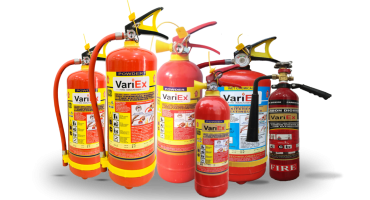 Read more +24 November 2023 in Fire Extinguisher
What types of fire extinguishers are available for different fire classes?
 Read more +02 May 2026 in Fire Extinguisher
Class B Fire Extinguisher Uses, Types, Price & Buying Guide
 Read more +30 April 2026 in ABC Fire Extinguisher, AMC Services, CO2 Fire Extinguisher, Fire Extinguisher, Fire Fighting System, FIre Hydrant, Fire Safety Equipment, Fire Safety Equipment